Market Overview – Week 28/26
2026-07-10

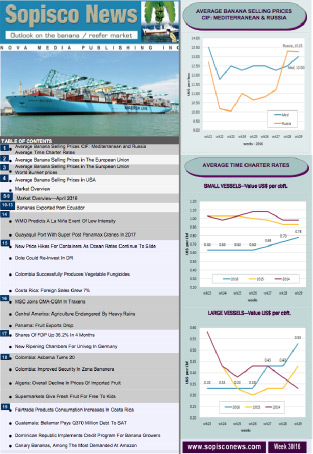
In week 28, the price of bananas in St. Petersburg ranged from USD 16.60 to USD 17.25 per box, CIF. Approximately 1.05 million boxes were discharged this week. Local traders reported that one vessel scheduled to arrive in week 28 was rescheduled for week 29, during which around 1.835 million boxes are expected to be discharged.
The USD exchange rate was 76.40 RUB.
In the Mediterranean region, Ecuadorian bananas were priced at around USD 16.00-17.00 per box, CIF, depending on the brand, volume, region, and packaging. Bananas from Central America were sold for about USD 2.00 per box less.
In the Mersin Free Zone, re-exported Ecuadorian bananas were available at prices ranging from USD 15.00 to USD 17.00 per box, also depending on the brand, volume, packaging, and weight. Bananas from Central America were priced at around USD 15.00 per box, which is approximately USD 2.00 less than their Ecuadorian counterparts.
The USD exchange rate in this region was 46.98 TL.
The Iranian domestic market faced significant disruptions during the week of Ayatollah Ali Khamenei’s funeral from July 4 to July 9, 2026. Economic activities across banking, business, logistics, transportation, and public administration were severely impacted. Authorities enforced mandatory closures, compelled attendance, and directed resource mobilisation, effectively halting large parts of the economy.
As the country entered a subdued mourning phase, normal economic life was eclipsed by state-organised ceremonies. Commercial activity plummeted, with many shops and offices closing under government orders or due to external pressure. Public-sector employees were redirected to participate in the funeral, reducing the availability of administrative and banking services and leaving many institutions minimally staffed.
Logistics and transportation were also affected, as terminal operations were limited, and ticket sales were suspended for several days. Companies were asked to reallocate resources to support the ceremonies, further constraining the movement of goods and people. Additionally, industrial firms and private businesses were obliged to contribute financially or materially to the events, compounding the burden during a time already marked by inflation and reduced purchasing power.
Overall, the atmosphere was one of interruption and slowdown, with daily business, banking, and transportation operating at a reduced pace while the country focused on an extended period of mourning.
During the week, the market experienced a lull, primarily due to seasonal factors affecting consumption. High summer temperatures, an abundance of competitively priced domestic fruits, and ongoing economic uncertainty have contributed to decreased demand and slower trading activity in wholesale markets. The price of Ecuadorian bananas ranged from 180,000 to 210,000 Toman per kilogram, while a 13.50 kg box of Indian bananas cost around USD 13.00, CIF, to Bandar Abbas.
Trade was affected not only by the high temperatures but also by the large volumes of local seasonal fruit being sold at much more competitive prices than imported bananas. Additionally, the progressive devaluation of the Iranian Toman (IRT) contributed to difficulties; the local currency dropped to 182,000 against the USD. High ocean freight rates to Mersin, along with the costs of additional trucking from the Turkish transit port to Iran, compounded these issues. There were also challenges in securing enough trucks to transport the bananas.
In the coming weeks, trade will depend heavily on geopolitical factors and on whether ships can transit through the Strait of Hormuz without restrictions or danger. Furthermore, reports indicated that the Port of Bandar Abbas, a major entry point for Indian bananas, was bombed by the USA, along with other minor Iranian ports, complicating trade even further. A major hurdle remains Iran's intention to control ship traffic in both the southern channel near the Omani coast and the northern part of the strait near the Islamic Republic.
Prices in the Ecuadorian spot market are currently under severe pressure due to lower demand. Banana growers are engaged in cleaning, constructing new drainage canals, installing pumping systems, and building retaining walls to protect their farms from excess water and potential flooding associated with the incoming El Niño.
Despite the damages caused by strong winds to banana plantations in Guatemala, there has been no additional sourcing from Ecuador in the immediate aftermath of these incidents. After further assessment, it is estimated that around 4,000 hectares of farms have been damaged, resulting in a probable loss of around 150,000 boxes of bananas per week, which may continue until the end of the year.
Additionally, market watchers report that banana farms in West Africa have also suffered damage from floods caused by heavy rains, a consequence of the early effects of the El Niño phenomenon. This may lead to reduced crop yields in October and November.
In other regions of Central America and beyond, assuming favourable conditions from El Niño, there might be an excess of bananas available starting in weeks 33-35 and continuing until weeks 45-46, or even longer.
In the Chartering Market, Time Charter rates were at almost the same levels as the previous week, for larger ships ranging from 60 to 65 US cents per cubic foot per month, while smaller vessels were priced at around 70 to 75 US cents per cubic foot per month.
Bunker Prices:
VLSFO MGO
Rotterdam $608.00 $980.50
Gibraltar $620.00 $1102.00
Panama Canal $632.00 $1138.00