France Leads the Way in Puerto Antioquia, Colombia
2026-06-05
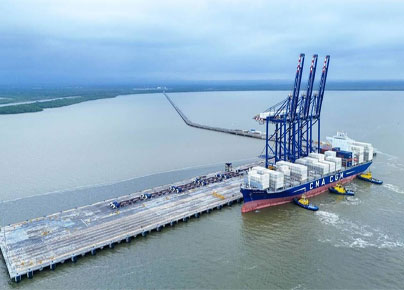
In a striking scene for Colombia's Urabá region—a mangrove area nestled between the Caribbean Sea and Panama—a Super-Post Panamax ship, capable of carrying 15,000 containers, is docked at a 1,340-meter offshore platform. This platform, connected to the land by a 3.8-kilometre viaduct, was designed by the French company Eiffage. It serves as the gateway to Puerto Antioquia, a massive port inaugurated this year, designed to reduce the distance between Colombia's producing regions and European markets. The goal is to enhance transatlantic trade, particularly with France, whose companies have invested significantly in the project.
Puerto Antioquia is poised to become a key hub for Colombian trade in a region long neglected by the government. Designed as a multi-purpose terminal, it can handle agricultural products, dry bulk, various goods, and even vehicles. Its strategic location relative to Bogotá and Medellín, compared with other Caribbean ports, is expected to save exporters of bananas, avocados, and coffee, among other products, considerable time.
A comprehensive French private ecosystem supports this achievement. In addition to Eiffage (offshore work), other companies such as Egis (supervision), Setec (engineering), and CMA CGM (the shipowner responsible for port operations) are involved. Importantly, the French government has not invested any funds; however, according to the Quai d'Orsay, it has backed this "first-rate project in Latin America," which strengthens France's presence in a rapidly growing region. In November 2025, the French Minister of Foreign Affairs, Jean-Noël Barrot, even visited the site.
France is already a strong economic partner of Colombia, with trade valued at €1.4 billion in 2025 and a €300 million surplus. Puerto Antioquia has the potential to capture 65% of Colombian banana exports and 20% of coffee exports, both of which are highly sought after in Europe. More importantly, the port is part of a larger initiative: the first link in a rail system connecting the Atlantic and the Pacific, providing a direct alternative to the Panama Canal, according to Manuel Naranjo, the secretary of economic development for the department of Antioquia.
"Puerto Antioquia must facilitate trade between Colombia, Europe, the United States, and the Americas, especially as the sector anticipates an increase in containerised flows between Europe and South America," states CMA CGM. The project, with a capacity of 7 million tonnes per year, costs $770 million and was financed through a blended model involving domestic and international private capital, multilateral development banks, and other financial institutions.
However, a significant challenge remains. Uraba serves as a crucial exit point for cocaine destined for Europe, controlled largely by the Clan del Golfo, a crime syndicate. The NGO Pares describes Urabá as a region deeply influenced by organised crime. On May 28, anti-drug trafficking police intercepted 4 tonnes of cocaine at the Puerto Antioquia facilities. Operators claim they have prepared for this challenge by integrating technologies such as scanners and digital container traceability, and by fostering rapid collaboration with police forces. Whether these measures will be sufficient to deter cartel infiltration remains uncertain.
Diego Legrand (special correspondent in Puerto Antioquia) reported on the CMA CGM Fiordland at Puerto Antioquia on February 11, 2026. The port platform, which cost $770 million to build, has the potential to capture 65% of Colombian banana exports and 20% of coffee exports.