Top Five Container Lines Have Over 30 ships with 306,000 TEU Stranded in Hormuz
2026-05-01
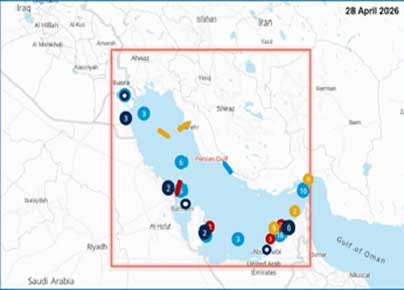
According to Seaexplorer data, 34 vessels from the world's largest carriers are immobilised in the Persian Gulf, prompting Hapag-Lloyd to implement alternative cargo movement arrangements.
As of April 28, 2026, these 34 vessels represent over 306,000 TEU of the region's total 345,092 TEU stranded—nearly 88% of the total capacity. Recent attempts by two major carriers to move ships out of the Gulf were thwarted by the seizure of two MSC vessels, further delaying operators navigating the Strait of Hormuz.
Hapag-Lloyd's CEO, Rolf Habben Jansen, is awaiting a "window of opportunity" to enter the strait. The carrier has successfully extricated one vessel, the 4,253 TEU Tema Express, which reappeared after a month-long AIS blackout.
Currently, 103 container ships are in the Persian Gulf. CMA CGM leads with 11 immobilised vessels, followed by MSC (10), Maersk (6), Hapag-Lloyd (4), and COSCO (3). The largest vessels include CMA CGM Everglade and CMA CGM Galapagos (both 15,254 TEU) and MSC's Express Rome (10,114 TEU). The largest overall is HMM Daon (16,010 TEU) from HMM Company Limited. Evergreen has also immobilised three vessels since early March.
If the situation persists, there could be operational impacts in the coming months. A Journal of Commerce report suggests long-term oil shortages could significantly affect global manufacturing and container volumes. Hapag-Lloyd's CEO mentioned that alternative arrangements have been made for 92% of stranded cargo, ensuring clear delivery dates. These may involve blank sailings and routing adjustments, possibly leading to increased investment in Middle Eastern ports and infrastructure.
While the Hormuz crisis has disrupted vessel movement, Drewry believes market volatility is less severe than during the COVID pandemic. Unlike air freight, container shipping has not seen a significant decline in capacity since the war in Iran began, except on routes to and from the Gulf. Overall, regional disruption is notable, but broader market conditions remain stable compared to past global crises. Drewry believes market volatility is less severe than it was.
The system includes solar modules, smart meters, a communications network, and automated controls, which facilitate more precise management of energy consumption related to water pumping.